Your credit score follows you through some of the most important financial decisions of your life — buying a home, financing a vehicle, opening a credit card, or taking out a personal loan. The most widely used version of that score is your FICO® Score. Understanding how it works puts you in a better position to protect it, improve it and put it to work for you.
What Is a FICO® Score?
FICO® Scores are the credit scores used by 90% of top lenders. Developed by the Fair Isaac Corporation, a FICO® Score is a three-digit number ranging from 300 to 850 that represents your creditworthiness based on your credit history. The higher the number, the lower the risk you present to a lender.
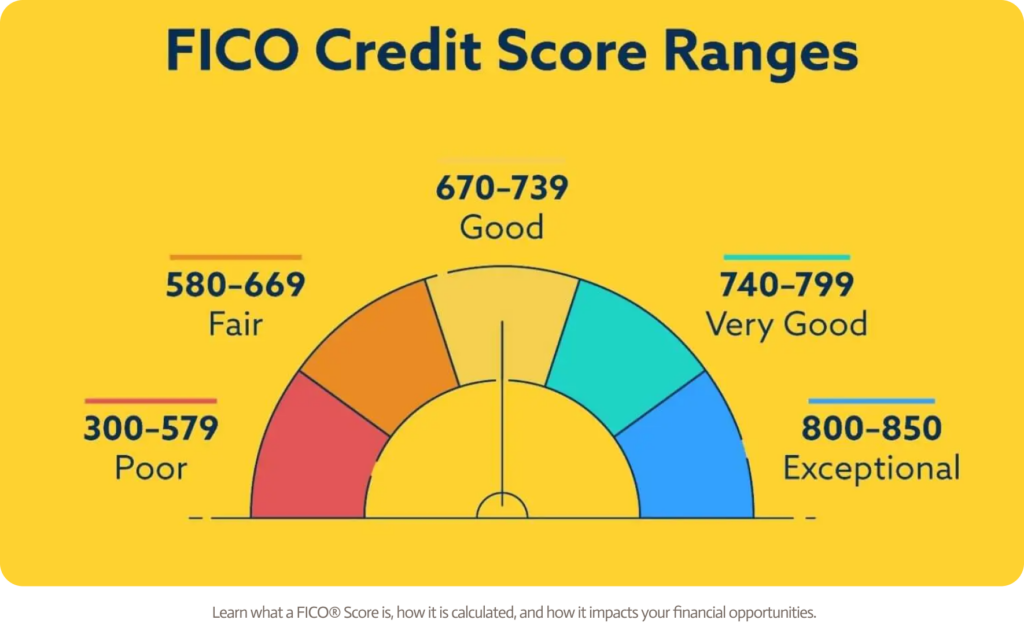
FICO® Scores are generated using data from your credit report, which is maintained by the three major credit bureaus: Equifax, Experian and TransUnion. Because each bureau may hold slightly different data, your score can vary slightly depending on which bureau a lender pulls from. In general, scores fall into the following ranges:
- 800 to 850 — Exceptional. Access to the best rates and terms available.
- 740 to 799 — Very Good. Likely to receive better-than-average rates from lenders.
- 670 to 739 — Good. Near or slightly above the national average; most lenders consider this a favorable range.
- 580 to 669 — Fair. Some lenders will approve credit at this range, though often at higher rates.
- 300 to 579 — Poor. Credit approval may be difficult; rebuilding habits will be necessary over time.

Why Your Score Matters
Lenders use your FICO® Score to decide whether to extend credit to you and at what terms. A strong score can mean the difference between qualifying for a mortgage at a competitive rate or paying significantly more in interest over the life of the loan. The same applies to auto loans, credit cards and lines of credit.
Beyond borrowing, your credit profile can also factor into rental applications and in some cases employment background checks. A healthy FICO® Score is one of the most practical financial tools you have.
How Your Score Is Calculated
Your FICO® Score is not based on income, age, or employment status. It is calculated entirely from your credit history using five weighted factors.
Payment history (35%) is the single largest factor. It reflects whether you pay your accounts on time. A pattern of on-time payments builds your score steadily over time. A single missed payment can have a meaningful negative impact and late payments and collections can linger on your report for up to seven years.
Amounts owed (30%) looks at how much of your available credit you are currently using, known as your credit utilization rate. If you have a combined credit limit of $10,000 across your cards and are carrying a $4,000 balance, your utilization rate is 40%. Lenders generally prefer to see utilization below 30% and the lower the better.
Length of credit history (15%) considers how long your accounts have been open, including the age of your oldest account, your newest account and the average age across all accounts. Longer histories are viewed more favorably, which is one reason closing old accounts can sometimes hurt your score.
New credit (10%) tracks recent applications for credit. Each time you apply for a new loan or credit card, a hard inquiry is placed on your report, which can temporarily lower your score. A high number of applications in a short window can signal financial stress to lenders.
Credit mix (10%) reflects the variety of credit types you manage, including credit cards, installment loans such as auto or student loans and mortgage loans. Demonstrating that you can responsibly manage different types of credit is viewed positively, though this factor carries less weight than the others.
How to Maintain or Improve Your Score
A strong FICO® Score is built through consistent habits over time. There are no shortcuts, but the path is straightforward.
Pay every bill on time. This is the single most impactful thing you can do. If you have missed payments in the past, getting current and staying current is the most effective way to begin rebuilding. Consider setting up automatic payments for at least the minimum due on each account.
Keep your credit utilization low. Aim to use no more than 30% of your available credit limit on any individual card or across your cards in aggregate. Paying down balances — even partially — before a statement closing date can help keep utilization low when your report is updated.
Do not close old accounts you are not actively using. Closing a card, particularly one you have held for a long time, reduces your available credit and shortens your average account age. Both of those changes can lower your score. If the card has no annual fee, leaving it open and occasionally making a small purchase to keep it active is usually the better approach.
Be selective about applying for new credit. Each application for a new loan or card generates a hard inquiry. If you are planning to apply for a mortgage or auto loan in the near future, avoid opening new credit accounts in the months leading up to the application.
Build a healthy credit mix over time. You do not need to take on debt you do not need just to diversify your credit mix. However, responsibly managing a combination of credit types — a card here, an installment loan there — will naturally strengthen this factor as your credit history grows.
Monitor your credit report for errors. Errors on your credit report can drag your score down without your knowledge. You are entitled to a free copy of your report from each bureau annually at AnnualCreditReport.com. Review each report for accounts you do not recognize, incorrect balances, or outdated negative items and dispute any errors directly with the bureau.